


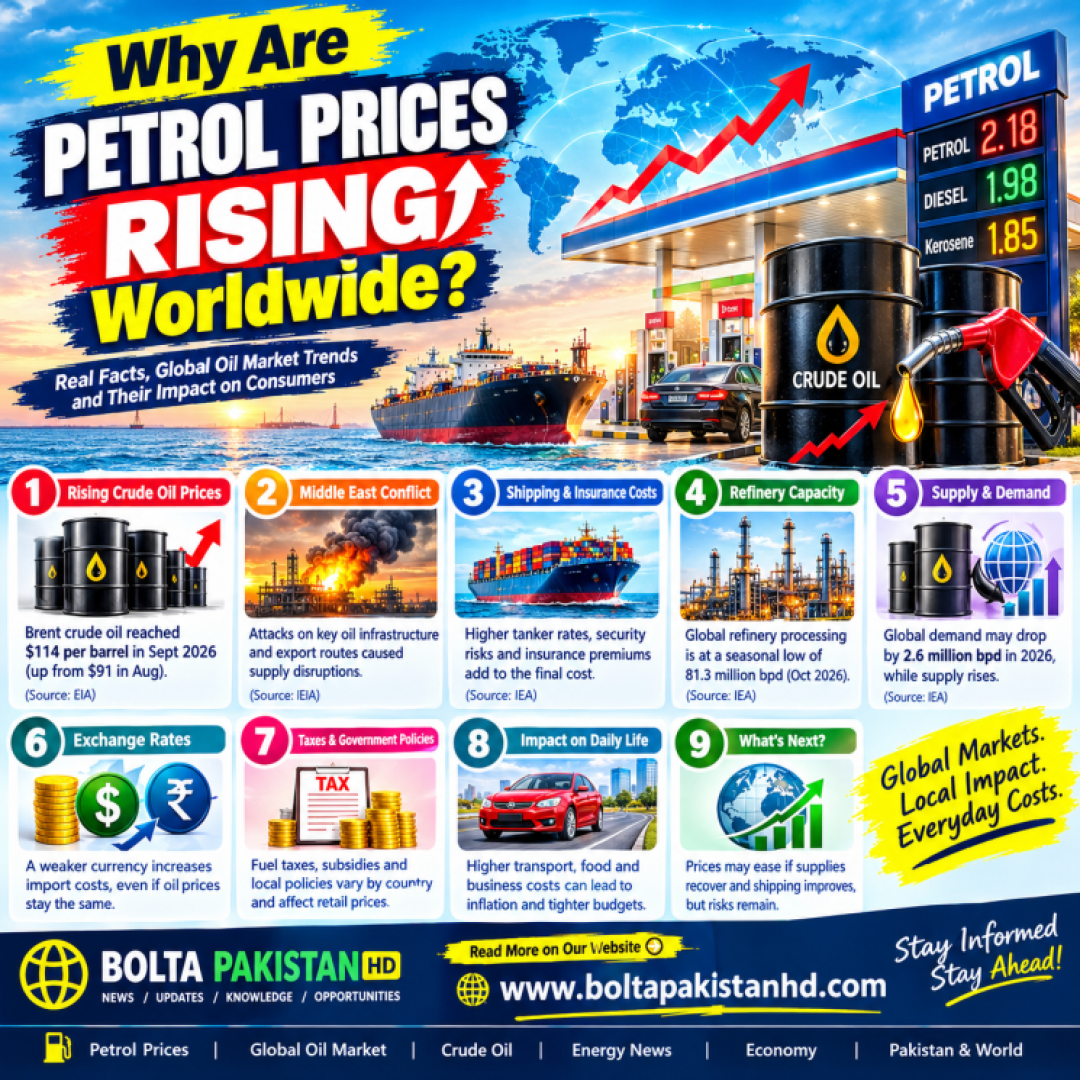
Petrol is more than a fuel used by cars and motorcycles. It is a fundamental part of the modern economy, connecting farms, factories, markets, transport networks and millions of households. When petrol becomes expensive, the effects can spread far beyond filling stations, increasing the cost of moving goods, delivering food and running businesses.
In October 2026, international oil markets are facing renewed pressure from geopolitical conflict, restricted export routes, rising tanker costs and uncertainty about future supplies. These factors have pushed crude oil prices sharply higher and made fuel markets increasingly unpredictable.
According to the US Energy Information Administration (EIA), the average Brent crude oil spot price reached $114 per barrel in September 2026, an increase of $23 from August. This rise followed attacks on important oil infrastructure in the Middle East and disruptions affecting export routes.
The situation demonstrates an important economic reality: petrol prices are influenced not only by how much oil the world produces, but also by whether that oil can reach refineries and consumers safely, quickly and affordably.
1. Rising Crude Oil Prices: The Foundation of Petrol Costs
Crude oil is the main raw material used to manufacture petrol and several other fuels. When crude oil becomes more expensive, refineries generally face higher production costs, which can eventually affect petrol prices at filling stations.
The EIA's October 2026 outlook provides the following annual figures for Brent crude oil spot prices:
Year
Average price per barrel
2024
$81
2025
$69
2026 forecast
$96
2027 forecast
$84
Source: US Energy Information Administration, October 2026 Short-Term Energy Outlook. The 2026 and 2027 figures are forecasts, not completed annual averages.
These figures show how quickly oil market conditions can change. The forecast average for 2026 is approximately 39% higher than the 2025 average of $69 per barrel.
The September price of $114 was also substantially above the 2025 annual average. However, a temporary increase in crude oil prices does not automatically translate into an identical percentage increase in retail petrol because refining costs, taxes, exchange rates and government pricing policies also matter.
2. Middle East Conflict and Oil Supply Disruptions
One of the most significant reasons behind the latest oil price pressure is instability in the Middle East, a region that plays a central role in international energy trade.
Conflict can affect oil production facilities, pipelines, ports, tanker movements and export terminals. Even when oil wells remain operational, the fuel may become more expensive if transporting it to international buyers becomes difficult or dangerous.
The EIA reported that attacks on Saudi Arabia's East-West Pipeline temporarily disrupted a key export route. Before the attacks, the pipeline was estimated to be carrying more than 5 million barrels of oil per day towards the Red Sea port of Yanbu.
The resulting supply uncertainty encouraged buyers to compete for available oil, helping push daily Brent spot prices as high as $131 per barrel on September 15, 2026.
This illustrates why energy markets react so strongly to geopolitical events. Traders consider not only the oil currently available but also the possibility that future deliveries may be delayed or cancelled.
3. The Strait of Hormuz: A Critical Route for Global Energy
The Strait of Hormuz is one of the world's most strategically important maritime passages. It connects the Persian Gulf with the Gulf of Oman and the wider international shipping network.
Oil exporters in the Gulf depend on this route, alongside alternative pipelines and other shipping arrangements, to reach international customers.
When tanker traffic faces security threats, shipping companies may charge higher rates, insurers may increase premiums, and vessels may need to take longer or less convenient routes. Each additional cost can increase the final price paid by refineries.
The effect is not limited to countries that import oil directly from the Middle East. Because crude oil is traded internationally, disruptions in one major exporting region can influence prices across multiple continents.
For this reason, developments around the Strait of Hormuz can affect fuel costs in Asia, Europe and other markets even when their domestic petrol supplies appear stable.
4. Higher Shipping and Insurance Costs
Oil does not travel from a production field to a petrol pump without expense. It must be transported through pipelines, ships, terminals and storage facilities before reaching refineries and distribution networks.
In October 2026, the International Energy Agency (IEA) reported that record freight rates and elevated crude costs were putting pressure on refinery economics in Europe and Asia.
Higher tanker insurance premiums, security concerns and longer shipping journeys can make each delivered barrel more expensive. These costs can also reduce the availability of ships, delaying deliveries and making supply chains less flexible.
The result is a double pressure on fuel markets: the raw material may become more expensive at the same time that the cost of transporting it increases.
5. Refinery Capacity and the Price of Finished Petrol
Crude oil cannot be poured directly into a car's fuel tank. It must first be processed at a refinery into usable products such as petrol, diesel, jet fuel and other petroleum products.
Refinery maintenance, equipment failures, regional shutdowns and shortages of suitable crude oil can restrict the amount of finished fuel available to the market.
Even when crude oil prices stabilise, petrol prices may remain elevated if refineries are struggling to produce enough gasoline or if the international price of finished petrol rises faster than the price of crude.
The IEA's October 2026 report projected global refinery processing at a seasonal low of approximately 81.3 million barrels per day in October, before a projected recovery towards 84.6 million barrels per day by year-end.
These are estimates and projections for refinery throughput, not measurements of petrol production alone. They nevertheless demonstrate how refinery availability can influence fuel markets independently of crude oil production.
6. Supply and Demand: Why Markets React So Quickly
Oil prices are shaped by the balance between available supply and expected demand.
When buyers expect oil supplies to become scarce, they may seek to purchase additional volumes before prices rise further. This can intensify competition for immediate deliveries.
Conversely, when economic activity slows, fuel consumption may weaken, reducing pressure on prices.
The IEA's October 2026 report illustrates this complicated relationship. Despite the supply crisis and elevated prices, it forecast that global oil demand would decline by an average of 2.6 million barrels per day in 2026, with a year-on-year fall of 2.5 million barrels per day in the fourth quarter.
The agency also reported that global oil supply increased by 2.5 million barrels per day in September to approximately 102.3 million barrels per day.
These figures highlight an important distinction: rising prices do not necessarily mean global demand is increasing. Prices can rise when supply becomes harder to deliver, even as consumers respond by using less fuel.
7. Currency Exchange Rates and Petrol Prices
International crude oil is commonly priced in US dollars. Consequently, countries whose currencies weaken against the dollar may face higher import costs even if the dollar price of oil remains unchanged.
For example, an importer paying for the same barrel of crude oil in dollars will need more units of its domestic currency if that currency loses value.
The final effect depends on the exchange rate, import arrangements, taxes, refining expenses and local pricing policies. A weaker currency can therefore amplify an international oil price increase, while a stronger currency may partly offset it.
This is one reason petrol prices can change differently in two countries that purchase oil from the same international market.
8. Why Petrol Prices Differ Between Countries
International crude oil prices are only one part of the retail petrol price. The amount motorists pay at a filling station depends on several additional factors:
Government taxes and levies: Fuel taxes can represent a substantial share of the retail price.
Refining expenses: Turning crude oil into petrol requires energy, equipment and specialised industrial processes.
Transportation and distribution: Fuel must be moved from refineries or import terminals to local filling stations.
Currency movements: Exchange-rate changes affect the cost of imported oil and finished petrol.
Government subsidies and price controls: Some governments absorb part of an increase, while others pass more of the cost to consumers.
Local competition and regulation: Pricing structures and market conditions vary between countries.
Consequently, two countries can experience the same international oil price increase but see very different changes in their local petrol prices.
9. How Rising Petrol Prices Affect Ordinary People
The consequences of expensive petrol reach far beyond private motorists.
Transport and commuting: Drivers, motorcycle users, taxi operators and public transport businesses face higher fuel expenses.
Food prices: Farmers, wholesalers and retailers rely on transport to move agricultural products. Higher fuel costs can place additional pressure on food prices, although weather, production costs and market conditions also matter.
Business operations: Delivery companies, manufacturers and service providers may experience higher operating expenses, which can reduce profit margins or lead to higher customer prices.
Household budgets: Families may have less money available for education, healthcare, savings and other purchases when transport and essential goods become more expensive.
Inflation: Fuel price increases can contribute to inflation directly through petrol prices and indirectly through the cost of producing and transporting other goods.
However, the size of these effects differs across countries and depends on how long high fuel prices persist.
10. What Could Happen to Petrol Prices Next?
The future direction of petrol prices depends on several interconnected developments.
Prices could ease if oil production and exports recover, tanker traffic becomes safer, shipping costs decline and global inventories begin to rebuild. Increased refinery output and improved diplomatic conditions could also reduce pressure on fuel markets.
On the other hand, additional attacks on energy infrastructure, prolonged shipping disruptions or further restrictions on oil exports could keep prices elevated.
The EIA's October 2026 outlook projected that Brent crude oil would average $105 per barrel in the fourth quarter of 2026, before declining to an average of $87 per barrel in the second quarter of 2027 under its forecast assumptions.
These estimates are not guarantees. A significant change in geopolitical conditions, production levels or shipping availability could cause actual prices to differ considerably from the forecast.
Consumers and businesses should therefore avoid assuming that petrol prices will fall immediately after a single positive market announcement.
Conclusion: Petrol Prices Reflect More Than the Cost of Oil
The worldwide rise in fuel costs demonstrates how closely modern economies are connected to international energy markets. Crude oil prices, geopolitical tensions, shipping insurance, refinery capacity, exchange rates and government policies all contribute to the amount consumers eventually pay for petrol.
The latest figures from the EIA and IEA show that supply disruptions and transport difficulties have created substantial pressure in the 2026 oil market, even as higher fuel costs weigh on demand.
For consumers, the most important lesson is that petrol prices do not depend on a single factor. A lasting reduction will generally require more reliable supplies, safer shipping routes, adequate refinery capacity and improved market stability.
Until those conditions improve, fuel prices may remain sensitive to developments across the global energy industry, making petrol an important issue for households, businesses and governments alike.
Sources and References
US Energy Information Administration (EIA) — October 2026 Short-Term Energy Outlook: Global Oil Markets
International Energy Agency (IEA) — Oil Market Report, October 2026
Reuters — Oil Prices Rise on Attacks in Saudi Arabia and Shipping Risks, October 14, 2026
Editorial note: Market prices and forecasts in this article reflect information available as of October 15, 2026. Forecasts are estimates and may change as new information becomes available. Retail petrol prices vary by country and are not identical to crude oil prices.

Comments
Login to comment.
Day to day petroleum price increase really make people hand to mouth. Government should take necessary steps to stop this increase. People are suffering a lot.
Day to day petroleum price increase really make people hand to mouth. Government should take necessary steps to stop this increase. People are suffering a lot.