


Iran–USA War and Its Impact on the World Economy: Oil Prices, Inflation, Trade and the Future
Introduction: A Regional War With Global Economic Consequences
A war between Iran and the United States is not simply a military confrontation between two countries. Because the Middle East is central to international energy supplies and global shipping, prolonged conflict can affect the cost of fuel, food, transportation, manufacturing and everyday goods across the world.
The economic impact extends far beyond the battlefield. When oil shipments are disrupted, businesses face higher operating costs, governments struggle to control inflation, and ordinary families may find that their incomes no longer cover the same expenses.
By October 2026, the conflict's effects on energy markets and shipping routes had become a major concern for international economic policymakers. The International Monetary Fund (IMF) has warned that continuing conflicts and trade disruptions could intensify commodity-price pressures and weaken energy and food security.
1. The Strait of Hormuz: A Critical Point for the World Economy
One of the most important economic consequences of the Iran–USA conflict is the disruption of shipping through the Strait of Hormuz, a narrow waterway connecting the Persian Gulf with international maritime routes.
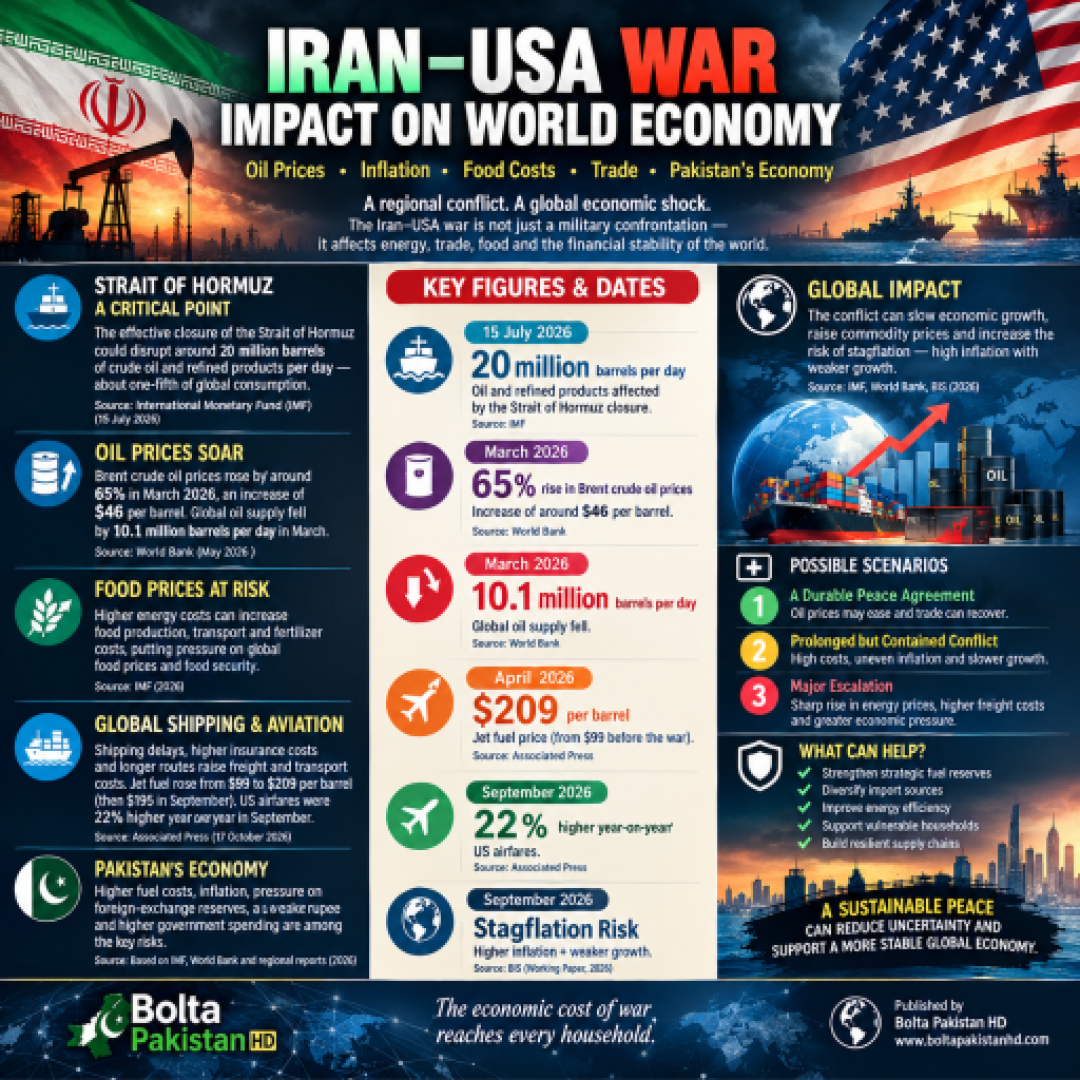
According to an IMF analysis published on 15 July 2026, approximately 20 million barrels of crude oil and refined petroleum products per day were affected by the effective closure of the strait. This represented roughly one-fifth of global consumption.
The disruption demonstrates how a single shipping route can influence the economic lives of people thousands of kilometres away. Even countries that do not purchase oil directly from the Gulf can face higher prices because international energy markets are interconnected.
Alternative pipelines and export terminals can redirect some supplies, but they cannot necessarily replace the entire volume that normally moves through the strait. Tanker availability, insurance costs, damaged infrastructure and shipping delays can further slow the recovery.
2. Oil Prices and the Risk of Another Inflation Wave
Oil is not just a fuel used by cars and trucks. It is an essential input for aviation, shipping, agriculture, industrial production and numerous chemical products.
The World Bank reported in May 2026 that Brent crude oil prices had increased by approximately 65% during March, a rise of around $46 per barrel. It also estimated that global oil supply fell by 10.1 million barrels per day in March amid the conflict and restrictions on tanker traffic.
These figures illustrate the scale of the supply shock. However, oil prices do not move in one direction indefinitely: they also respond to ceasefire announcements, alternative production, inventories, demand reductions and expectations about future shipping conditions.
If supply remains constrained, higher energy costs can spread through the economy in several ways:
Transport: Airlines, shipping companies and road-freight operators pay more for fuel.
Manufacturing: Factories face increased energy and materials expenses.
Agriculture: Farmers may pay more for diesel, irrigation, transportation and fertilizer.
Retail: Businesses may pass some of their increased costs on to consumers.
Public finances: Governments may spend more on fuel subsidies or emergency assistance.
The result can be a difficult combination: prices rise while economic growth slows.
3. Why the War Can Make Food More Expensive
The connection between war and food prices is often less visible than the connection between war and petrol prices, but it can be equally important.
Modern agriculture depends on fuel-powered machinery, transport networks, irrigation and industrial fertilizer production. Natural gas is also a key input in the manufacture of nitrogen fertilizers.
When energy supplies become expensive or uncertain, farmers may face higher production costs. Food distributors then pay more to store and transport crops, while import-dependent countries can face additional pressure from exchange-rate movements.
Poorer households are particularly vulnerable because food accounts for a large share of their spending. Even a moderate increase in the price of flour, cooking oil, vegetables or other staples can force families to reduce spending on healthcare, education and other necessities.
The IMF has identified food security and the rising cost of essential goods among the risks associated with prolonged energy and trade disruptions.
4. Global Shipping, Aviation and International Trade
The effects of the conflict are not limited to oil tankers. Shipping companies must also consider vessel availability, security risks, insurance premiums and the possibility of rerouting journeys.
Longer routes can mean more fuel consumption, additional sailing days and delayed deliveries. Manufacturers that rely on imported components may struggle to maintain production schedules, while retailers can face higher freight bills.
Aviation is another exposed sector. Jet fuel is a major airline expense, so sustained price increases can lead to higher ticket prices, reduced flight schedules or weaker profitability.
In an Associated Press report published on 17 October 2026, jet fuel was reported to have risen from a worldwide average of about $99 per barrel before the war to $209 in April, before reaching nearly $195 in September. The report also noted that US airfares were approximately 22% higher year over year in September.
These are US-market indicators rather than a direct measure of global airfare inflation, but they demonstrate how an energy shock can eventually reach consumers through travel and transportation.
5. The Impact on Pakistan's Economy
Pakistan is especially exposed to international energy-price increases because imported energy contributes to the country's fuel and foreign-exchange requirements.
If global oil prices rise, Pakistan may face several economic pressures:
Higher petrol and diesel costs: Expensive imported fuel can increase transport fares, freight charges and the cost of moving agricultural products to markets.
Inflation: Businesses may raise prices to cover increased electricity, fuel, packaging and delivery costs.
Pressure on foreign-exchange reserves: If the value of energy imports increases, Pakistan may need more foreign currency to purchase a similar volume of supplies.
Pressure on the rupee: Greater demand for foreign currency can add to exchange-rate pressure, depending on export earnings, remittances, capital flows and policy measures.
Higher government expenditure: Authorities may face difficult choices between passing fuel costs on to consumers and spending public money to cushion the impact.
Challenges for industry: Transport-intensive sectors, including textiles, food processing and manufacturing, may see their production and export costs rise.
The final outcome depends on how long disruptions last, the direction of global prices, Pakistan's exchange rate, domestic taxes, energy policies and the availability of alternative supplies. Higher oil prices do not automatically produce the same level of inflation in every country.
6. How the Conflict Could Affect the United States
Although the United States is a major energy producer, domestic consumers and businesses are not completely protected from international oil-price shocks.
Oil is traded in connected global markets. When international supplies become less secure, prices can rise even in countries that produce substantial quantities of petroleum.
American households can consequently face higher costs for petrol, air travel and transported goods. Businesses may have to choose between absorbing additional expenses, reducing profit margins or increasing prices.
At the same time, higher energy prices can benefit some oil-producing companies and regions. This means the economic effects are uneven: energy producers may gain revenue while consumers, transport businesses and energy-intensive industries face higher costs.
7. Could the World Economy Enter a Period of Stagflation?
Stagflation describes a situation in which inflation remains high while economic growth weakens. A prolonged energy-supply disruption can increase this risk because it makes production more expensive and reduces the purchasing power of households.
A September 2026 working paper from the Bank for International Settlements examined how disruptions at maritime chokepoints, including the Strait of Hormuz, affect energy and fertilizer prices, industrial production, consumer prices and financial conditions. Its findings linked adverse shipping disruptions with higher commodity prices, weaker output and tighter financial conditions.
However, stagflation is a risk, not an inevitable outcome. Additional oil production, strategic stock releases, lower demand, functioning alternative routes and a durable diplomatic agreement could limit the damage.
The longer the disruption continues, the more difficult it may become to restore production, shipping confidence and normal trade flows.
8. Three Possible Economic Scenarios
Scenario One: A Durable Peace Agreement
If Iran and the United States reach a lasting agreement and shipping through the Strait of Hormuz returns to normal, oil prices could ease as supplies recover and market uncertainty declines.
Transport costs may gradually improve, businesses could restore delayed deliveries, and governments might have more room to control inflation. Nevertheless, damaged infrastructure and depleted inventories could mean that recovery takes months rather than days.
Scenario Two: A Prolonged but Contained Conflict
If hostilities continue without causing a complete breakdown in international energy trade, the world economy could face persistently high costs, uneven inflation and slower growth.
Countries with diversified energy supplies and stronger public finances would generally be better positioned to absorb the shock. Energy-importing developing economies could experience greater pressure on household budgets and government spending.
Scenario Three: A Major Escalation
A further deterioration in security around critical shipping routes or damage to major energy facilities could reduce supplies more severely.
In this scenario, energy prices could rise sharply, insurance and freight costs could increase, and businesses might delay investment. Countries with limited foreign-exchange reserves and high debt burdens would face particularly difficult choices.
These are conditional scenarios, not predictions of what will happen.
9. What Governments and Businesses Can Do
The crisis highlights the importance of preparing for energy disruptions before they occur.
Governments can strengthen strategic fuel reserves, diversify import sources, improve electricity efficiency and provide targeted support to households most affected by higher prices. Temporary assistance should be designed carefully so that it does not create unsustainable fiscal costs.
Businesses can reduce exposure by diversifying suppliers, reviewing logistics arrangements, improving energy efficiency and planning for temporary interruptions to essential materials.
Over the longer term, renewable electricity, electrified transport and more resilient supply chains can reduce dependence on a limited number of fuel sources. These changes require investment, but they can also reduce vulnerability to future international crises.
Conclusion: The Economic Cost of War Reaches Every Household
The Iran–USA conflict demonstrates how geopolitical tensions can become an economic challenge for the entire world. A disruption affecting oil shipments in the Middle East can influence petrol prices, food production, aviation, industrial output and government budgets across continents.
The figures reported in 2026 reveal the scale of the risk: the IMF estimated that around 20 million barrels per day of oil and refined products were affected by the effective closure of the Strait of Hormuz, while the World Bank documented a sharp rise in oil prices and a major fall in global supply during March.
Yet the eventual economic damage will depend on the duration of the conflict, the security of shipping routes, the condition of energy infrastructure and the success of diplomatic efforts.
For Pakistan and other energy-importing countries, the priority is to protect vulnerable households, manage foreign-exchange pressures and strengthen long-term energy security. A sustainable peace would offer the clearest opportunity to reduce uncertainty and support a more stable global economy.
Published by Bolta Pakistan HD — www.boltapakistanhd.com
Iran–USA War and Its Impact on the World Economy: Oil Prices, Inflation, Trade and the Future

Comments
Login to comment.